Tuesday, January 31, 2012

Butterball Weaners


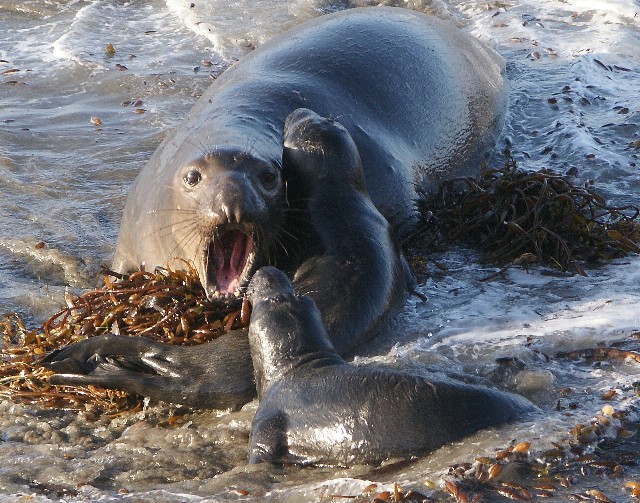
Despite the extraordinarily aggressive behavior of many of the moms this birthing season, most of the pups have flourished and many are now entering the stage of weanerdom. ( The pups are renamed weaners when the mom turns off the milk spigot after about 4 weeks of nursing and heads out to sea to feed and replenish her lost weight, leaving her offspring on shore to fend for itself. )

The biggest danger to the pups this birthing season has not been severe storms or amorous males looking to mate but the unusally pugnacious actions of many of the moms. These females have been quick to dash across several yards of beach to bite or even pick up and toss pups through the air with extreme regularity as can be evidenced by the large number of cuts and bite marks on nearly all the pups/weaners.


Maybe because the alpha males have successfully kept at bay what few love-struck males have tried to gallop across the beaches to mate with unwilling females, the nursing pups and their moms have largely remained uninterrupted over the bulk of the birthing season.

( It's not that the males intend harm to the pups, but their intrusions create unrest and force the moms and pups to keep moving around, cutting into nursing times and causing them to use up precious calories.)

Click here to see video of pups/weaners trying to wiggle their way out from under a huge bull.

In the photos, you can see how truly huge some of these weaners have become. Some of them have even almost attained the length of their moms in just a few short weeks of gorging themselves !
( Since so many of the weaners are big, round and comical this year, I feel tempted to nickname them butterballs.)

Click here for weaner and pup photos.

Nevertheless, in the last few days, more males have been starting to show up, and now the previously half-hearted mating attempts are getting more serious. At least these males are starting to achieve their goals with the now more complacent younger adult females before gettting run off the beaches by this year's more-than-usual protective alpha males or other large males intent on getting their share of the mating. ( Scientists claim that the females enter into estrus about 3 weeks after giving birth. )

Click here for photos of males in action.

Click here for video of various mating attempts.

Tuesday, January 17, 2012

Protecting Pups from High Tides


With the birthing season in full swing, I thought I should cover some of the ways the elephant seals try to protect their pups when huge ocean swells combined with high tides temporarily take over the beaches.

Some females often place themselves between their pup/s and the sea. Some try to find a high spot like a good bed of kelp. Some try to move up creek beds or low-lying bluffs. Some just keep moving around.

If a pup does get taken out by a surge, however, the next wave will usually bring it right back in. When a pup gets swept out, its frantic mom will usually dash off into the surf in search of her offspring to guide it back to shore. Not only do the moms take action but even the males can oftentimes be seen getting into the act of helping out by guiding the pups back towards shore.

Click here to see video from a recent high surge event.

Since I've been researching the elephant seals, I often hear misleading statements about various aspects of their behavior. Because of these many misconceptions, I've decided to voice my thoughts on some of these based on my observations.

Below are some of the beliefs that I believe should be addressed.

Belief #1: Pups can't swim
False: Pups can swim...after all they are marine mammals born with the innate ability to swim. However, they don't have the necessary blubber to keep them warm. So if they get taken out in the tidal surges too often during their first couple of weeks of life, the very chilly waters of the Pacific Ocean along the central coast of California can cause them to suffer from hypothermia. This, of course, causes an inability to move resulting in their drowning.

Belief #2: Males kill pups
False: The males I've observed over the past several years tend to show a lot of tenderness towards the pups and try to avoid running over them when they're moving at full charge. ( The few times I've seen a pup getting run over by a massive bull, the youngster has bounced right back up protesting loudly ! )

Belief #3: Females are highly protective of their pups
True: Most females go to great lengths to protect their pups from any perceived threat, such as anything/anyone encroaching within a few feet of them. This aggressively protective behavior can include going after pups separated from their moms and the milk supply. Some females will even go so far as to bite and/or remove other pups from their vicinity by tossing them into the air. On the other hand, some females will take on pups that they didn't give birth to and nurse and protect them.

Belief #4: Males will mount anything
True: All males except the most senior ones always seem to be ready to mount any size, any age, any sex elephant seal at any given time. Not that they ever get anywhere in these desires...it just seems to be a part of their nature.

Belief #5: Adult Male Elephant Seals are always extremely aggressive
False: Adult males are generally not aggressive. For the most part, they tend to be rather mellow. There are times, though, when the mood strikes, that they will charge and attack other males after a series of ritualistic aggressive moves. Even on land, they can move extremely fast and cover several hundred yards at a good clip. Although hard blows can be exchanged and blood drawn by bites from their long canine teeth, truly serious injury or death are not par for the course.

Belief #6: They throw sand on themselves to stay cool
False: The reasons elephant seals throw sand on themselves is no doubt multifold. However, the belief that it helps them stay cool doesn't seem all that logical. ( If they're really hot, there's plenty of cool water in the Pacific. ) From my observations, one of the primary purposes of covering themselves partially with sand is a signal to others to leave them alone. ( They may even believe that the sand makes them invisible much as the ostrich seems to feel when it buries its head in the sand. ) Females also throw sand in the face of an amorous male as a deterrent to keep him and his unwanted advances at bay. Thirdly, females often bury the afterbirth by tossing sand on it to hide from the raucous ever-hungry gulls.


Returning to this birthing season's happenings...more adult males have come in. Yet, for the most part, they're still in a very mellow mood this time around with major bouts of fighting not taking place, and many females have still to give birth.

Click here to see recent photos.

Wednesday, January 4, 2012

Dramatic Elephant Seal Pup Births


Even though, many of the traditionally lively birthing beaches have not been richly populated as of yet as both the big adult males and females have been slow in returning to our shores, enough have showed up to contribute to this suddenly very busy early-birthing season. Last year at this time, males temded to be in the majority, but this year on some of the beaches, females and their newborn pups are just about the sole inhabitants.


Due to this sudden high concetration of pregnant females, I have been fortunate enough to witness two amazing births so far. The first one was a struggle taking about twenty minutes to complete, whereas the other that took place at sunset was extremely fast...probably less than five minutes. Watch as both pups come out tail flippers first. Then watch as the mom and her newborn pup bond by smell.


Click here to watch an exciting birthing video as a female elephant seal struggles to bring forth her pup.

Click here to watch a fascinatingly easy birth at sunset.

Friday, December 30, 2011

2011-2012 Birthing Season Is Upon Us


So far, this season is proving to be quite different from those of recent years as the usual often-seen bloody testosterone-driven territorial fights during the month of December haven't materialized.

Click here to see a video of the only truly bloody fight I've witnessed so far.

Instead, those adult male elephant seals that did come ashore starting in the early part of December came mainly just to rest and then move somewhere else. In the later part of December, some challenges were issued, but very few rose up to test their prowess.

Click here to see a video of some of this year's adult male early beahvior.

In regards to the females, first there were none on the birthing beaches, then only a handful could be seen around the middle of the month. Now, as December draws to a close, not only have many very pregnant females shown up on the smaller birthing beaches, but quite a few are also quickly giving birth to their adorable black pups. However, the normally huge numbers of pregnant females are still conspicuously absent from the big birthing beaches where they've always tended to show up first.

Click here to see video of a gentle giant.

The pregnant females that have arrived have had their flippers specially full this month dealing with the many energetic amorous younger males who are looking to mate with anyone of any age they can coerce into it. Interestingly enough, though, the alpha male will, for the most part, let the females show their skill at getting rid of these ardent younger males. Some of these new mothers have proven to be unusually vicious in defending themselves and their pups from unwanted attention this month.

Click here to see video of females in ferocious defense.

Click here to see photos from the past couple of weeks.

Wednesday, December 14, 2011

Elephant Seal Land Mid-December


Feisty youngsters will nearly always stand up for their rights even if it means going up against the biggest of the big.

Even though the Fall Haul-Out should be over, there are still many very active and captivating youngsters remaining on varying beaches.

Click here for more photos of youngsters in action.

Even though we're half-way through December, not too many of the 'good olde BIG BOYS' have shown up to claim California winter territory yet. Also, what's even more surprising is the lack of females. In fact, I've only observed a good amount of the fair sex on one beach....a beach that's not usually a birthing beach !

Click here for photos of some of the BIG BOYS.

Click here for video of the only 'Beach Chase' I've seen so far this season.

The younger adult males are busy participating in their preliminary bouts, most of which are lacking in tenacity at this point.

Click here for video of some of the yonger adult males in action.

Maybe the changes in coming ashore can be attributed to good fishing times, that we've been having a lot of off-shore winds and currents, or, just maybe, the elephant seals want to keep everyone in suspense ! Who knows ?

Click here for other photos from the past couple of weeks.

NEWS FLASH....the first pup of this birthing season was born a couple of days ago...probably Thursday, December 15th on one of the pocket beaches. A beach that so far only has 3-5 pregnant females on it. Maybe because this young mother is basically surrounded by males of all ages instead of being in a group of females, she is acting extremely anxious and is aggressively keeping all other elephant seals well away from her newborn baby girl. ( I have been alerted to the fact that a few other pups have been recently born on a couple of the larger beaches. )

Click here for photos of the newborn girl.

Click here for video action of pup and mom.

Monday, November 28, 2011

Astronomical Tides Causing Problems


Abnormally high and low tides have created quite a problem for the elephant seals on some of the central coast beaches.

Click here for more photos of the latest characters.

Thanks to huge mounds of kelp raising the height of some small beaches though, small havens have been formed where youngsters and pregnant females can get some rest ahead of the fast approaching birthing and mating seasons. Not finding room on what precious beach land that is available during the high tides, many of the rather feisty younger adult males have often been forced to stay off-shore and conduct their preliminary dominance fights in the water rather than on land. And many have proved themselves very adept at dealing aquatic punishing blows without the support of solid land beneath them. ( Interestingly enough, it seems that when the sea is in turmoil the elephant seals tend to be more aggressive. )

Click here for video of action-packed sub-adult male elephant seals.


A few larger adult males have already made it to shore, but apart from one bloody adult male, most of them seem content to sleep in preparation for the upcoming territorial fights.

Click here for video of pregnant females doing their thing.

Friday, November 11, 2011

Sub-Adult Males Are Dominating the Beaches and Shallows


Alongside the tan-colored bodies of mainly younger elephant seals that have been adorning some of the beaches of the Piedras Blancas elephant seal colony on the central coast of California for the past couple of months, more and more sub-adult males can be seen as well as heard.

Many of the sub-adult males are showing up in a feisty mood and have been putting on spectacular minor pugilistic shows both on land and in the shallows of the bays.

( Equality in size doesn't seem to be important as you can often observe much younger elephant seals challenging more mature ones. )

From the day they're born, most male elephant seals seem to spend much of their waking hours trying to dominate others, both male and female.

( It would be interesting to know how far back their memories stretch as sometimes they sniff each other upon meeting and don't engage in any sort of superiority fight at all. Whereas, at other times, they either sniff one another and immediately start to fight, or don't sniff at all but start fighting with little or no warning. )

A few of these newcomers, on the other hand, appear to be enjoying themselves peacefully floating around, eyes closed, under the surface in the unusually clear bay water. Then, there are still others that appear to be searching around for something, maybe something edible, in the nooks and crannies of the rocks in the shallow coastal water.

Click here for video of sub-adult males enjoying life in Californnia.

No matter the time of year, each elephant seal season always has something truly fantastic to present to the human onlookers.

Click here for photos.

Click here for video of sub-adult males in dominance mode.