
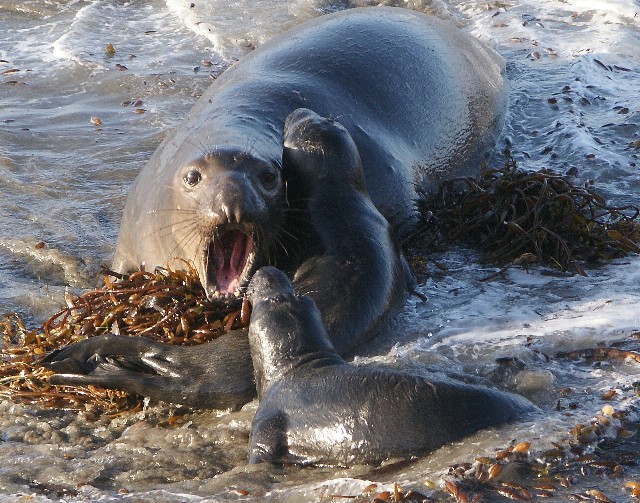
With the birthing season in full swing, I thought I should cover some of the ways the elephant seals try to protect their pups when huge ocean swells combined with high tides temporarily take over the beaches.
Some females often place themselves between their pup/s and the sea. Some try to find a high spot like a good bed of kelp. Some try to move up creek beds or low-lying bluffs. Some just keep moving around.
If a pup does get taken out by a surge, however, the next wave will usually bring it right back in. When a pup gets swept out, its frantic mom will usually dash off into the surf in search of her offspring to guide it back to shore. Not only do the moms take action but even the males can oftentimes be seen getting into the act of helping out by guiding the pups back towards shore.
Click here to see video from a recent high surge event.
Since I've been researching the elephant seals, I often hear misleading statements about various aspects of their behavior. Because of these many misconceptions, I've decided to voice my thoughts on some of these based on my observations.
Below are some of the beliefs that I believe should be addressed.
Belief #1: Pups can't swim
False: Pups can swim...after all they are marine mammals born with the innate ability to swim. However, they don't have the necessary blubber to keep them warm. So if they get taken out in the tidal surges too often during their first couple of weeks of life, the very chilly waters of the Pacific Ocean along the central coast of California can cause them to suffer from hypothermia. This, of course, causes an inability to move resulting in their drowning.
Belief #2: Males kill pups
False: The males I've observed over the past several years tend to show a lot of tenderness towards the pups and try to avoid running over them when they're moving at full charge. ( The few times I've seen a pup getting run over by a massive bull, the youngster has bounced right back up protesting loudly ! )
Belief #3: Females are highly protective of their pups
True: Most females go to great lengths to protect their pups from any perceived threat, such as anything/anyone encroaching within a few feet of them. This aggressively protective behavior can include going after pups separated from their moms and the milk supply. Some females will even go so far as to bite and/or remove other pups from their vicinity by tossing them into the air. On the other hand, some females will take on pups that they didn't give birth to and nurse and protect them.
Belief #4: Males will mount anything
True: All males except the most senior ones always seem to be ready to mount any size, any age, any sex elephant seal at any given time. Not that they ever get anywhere in these desires...it just seems to be a part of their nature.
Belief #5: Adult Male Elephant Seals are always extremely aggressive
False: Adult males are generally not aggressive. For the most part, they tend to be rather mellow. There are times, though, when the mood strikes, that they will charge and attack other males after a series of ritualistic aggressive moves. Even on land, they can move extremely fast and cover several hundred yards at a good clip. Although hard blows can be exchanged and blood drawn by bites from their long canine teeth, truly serious injury or death are not par for the course.
Belief #6: They throw sand on themselves to stay cool
False: The reasons elephant seals throw sand on themselves is no doubt multifold. However, the belief that it helps them stay cool doesn't seem all that logical. ( If they're really hot, there's plenty of cool water in the Pacific. ) From my observations, one of the primary purposes of covering themselves partially with sand is a signal to others to leave them alone. ( They may even believe that the sand makes them invisible much as the ostrich seems to feel when it buries its head in the sand. ) Females also throw sand in the face of an amorous male as a deterrent to keep him and his unwanted advances at bay. Thirdly, females often bury the afterbirth by tossing sand on it to hide from the raucous ever-hungry gulls.

Returning to this birthing season's happenings...more adult males have come in. Yet, for the most part, they're still in a very mellow mood this time around with major bouts of fighting not taking place, and many females have still to give birth.
Click here to see recent photos.


