Showing posts with label marine mammals. Show all posts

Tuesday, March 6, 2012

Time for a Change


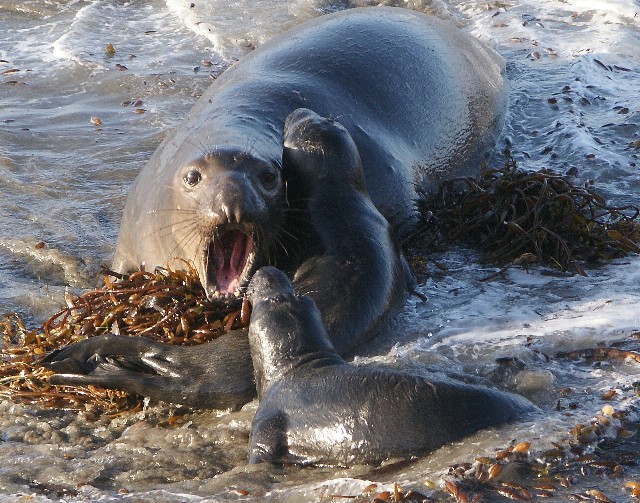
March is a time of change for the elephant seals as the crowded, noisy beaches of January and February have become almost empty of adults with only a few late-birthing moms, and a few tired, skinny but hopeful males, as well as some recuperating males still hanging around. The remaining brown-looking adult males are resting up and pooping as they prepare to leave to regain their lost weight, and maybe their lost pride as well. The remaining exhausted females are all too anxious to leave the attentions of these tired but unrelenting-in-their-sexual-efforts males and quickly regain their lost weight so they can start to nourish the new fetus in preparation for the next birthing season.

Click here for some of the last photos of adult males and females.


For the most part, however, most of these mainly skinny-looking males sporting still-healing battle wounds of scratches and tooth-marks are recuperating from this rather different birthing and mating season.
( The females seemed to be unusually bitchy, while the males seemed to be lacking in sufficient testosterone. Thus making successful mating rather a difficult proposition. )


Click here for photos of some the last matings of this season.

Towards the end of February, I was very fortunate to witness an amazing feat of strength and stamina on the part of one alpha male that went on a highly successful raid on a neighboring harem. Because of the length of the events, I split the video into two parts. Part 1 shows the lengthy fight where he temporarily banishes the reigning alpha male. Part 2 shows his triple mating !

Click here to see a shortened video of this lengthy 20/25-minute fight that took place towards the end of February. ( Very unusual at this time of the season )

Click here to see video of the triple mating.

As March moves along, it's the time for the weaners ( as the weaned pups are called ) to start fending for themselves.


The weaners are fun to watch as they try tasting varying objects on the beach, practice swimming in the creeks and/or tide pools, bicker amongst themselves, and spend plenty of time sleeping, preserving their mom-given fat-rich nourishing milk.

Click here for photos of young elephant seal weaners and almost weaners.

Saturday, February 11, 2012

Keys to Successful Elephant Seal Mating


Despite their fierce reputation, elephant seal males are, for the most part, quite peaceable except for when it comes to territorial rights and mating.

Click here for recent photos of the current residents at Elephant Seal Land.

Male elephant seal dominance fighting is part of their disposition, and, for the most part, these battles are fought without rancor.

Prior to this birthing/mating season, I've hardly ever seen a truly angry male elephant seal. This year, however, tolerance and patience seem to have been somewhat short on a few occasions.

Click here for video of a some crabby males

Also, since the mating season is in full swing, I thought it a good idea to try to describe with words, photos, and videos what actually leads up to a successful union.

Click here for photos of mating.

Alpha Male or Beachmaster is the term given to the dominant male that 'owns' a certain segment of the beach with all its resident females, pups and weaners. This time of year is an extremely busy one for these large males as they make valiant attempts to mate with ALL of the females of their so-called harem. In between convincing their females to mate, these huge males can be seen galloping madly across the beach staunchly defending 'theirs' from any and all would-be intruding lovers.

Below are some tongue-in-cheek tips that might be handed down from father to son throughout the realms of Elephant Seals.

Advice for a Would-Be Lover

1. Sneak ashore. Hide amongst the females and pups. Don’t draw attention to yourself.

2. You may have to go ashore behind the back of the alpha. Use waves, rocks and other seals as cover.

3. Try to find a quiet female. ( Almost impossible )

4. Quickly try to mount when opportunity arises….but keep and eye and ear open for an irate advancing alpha. Always be prepared to flee. Know where your quickest path back out to sea lies.

5. Wait for alpha to get tired from exertion, then make your move.

Advice for the Alpha Male

1. Keep other males away by patrolling waters and chasing amorous intruders off beach.

2. Allow some large males on peripheries to chase off other would-be lovers. ( Saves your time and energy. )

3. Choose a compliant female. Stay away from feisty females who bite and struggle fiercely to escape. Also watch out for females that gang up on you.

4. Don’t get interrupted by other advancing males.

5. Herd escaping females back to shore.


Click here for mating videos.

Tuesday, January 31, 2012

Butterball Weaners


Despite the extraordinarily aggressive behavior of many of the moms this birthing season, most of the pups have flourished and many are now entering the stage of weanerdom. ( The pups are renamed weaners when the mom turns off the milk spigot after about 4 weeks of nursing and heads out to sea to feed and replenish her lost weight, leaving her offspring on shore to fend for itself. )

The biggest danger to the pups this birthing season has not been severe storms or amorous males looking to mate but the unusally pugnacious actions of many of the moms. These females have been quick to dash across several yards of beach to bite or even pick up and toss pups through the air with extreme regularity as can be evidenced by the large number of cuts and bite marks on nearly all the pups/weaners.


Maybe because the alpha males have successfully kept at bay what few love-struck males have tried to gallop across the beaches to mate with unwilling females, the nursing pups and their moms have largely remained uninterrupted over the bulk of the birthing season.

( It's not that the males intend harm to the pups, but their intrusions create unrest and force the moms and pups to keep moving around, cutting into nursing times and causing them to use up precious calories.)

Click here to see video of pups/weaners trying to wiggle their way out from under a huge bull.

In the photos, you can see how truly huge some of these weaners have become. Some of them have even almost attained the length of their moms in just a few short weeks of gorging themselves !
( Since so many of the weaners are big, round and comical this year, I feel tempted to nickname them butterballs.)

Click here for weaner and pup photos.

Nevertheless, in the last few days, more males have been starting to show up, and now the previously half-hearted mating attempts are getting more serious. At least these males are starting to achieve their goals with the now more complacent younger adult females before gettting run off the beaches by this year's more-than-usual protective alpha males or other large males intent on getting their share of the mating. ( Scientists claim that the females enter into estrus about 3 weeks after giving birth. )

Click here for photos of males in action.

Click here for video of various mating attempts.

Tuesday, January 17, 2012

Protecting Pups from High Tides


With the birthing season in full swing, I thought I should cover some of the ways the elephant seals try to protect their pups when huge ocean swells combined with high tides temporarily take over the beaches.

Some females often place themselves between their pup/s and the sea. Some try to find a high spot like a good bed of kelp. Some try to move up creek beds or low-lying bluffs. Some just keep moving around.

If a pup does get taken out by a surge, however, the next wave will usually bring it right back in. When a pup gets swept out, its frantic mom will usually dash off into the surf in search of her offspring to guide it back to shore. Not only do the moms take action but even the males can oftentimes be seen getting into the act of helping out by guiding the pups back towards shore.

Click here to see video from a recent high surge event.

Since I've been researching the elephant seals, I often hear misleading statements about various aspects of their behavior. Because of these many misconceptions, I've decided to voice my thoughts on some of these based on my observations.

Below are some of the beliefs that I believe should be addressed.

Belief #1: Pups can't swim
False: Pups can swim...after all they are marine mammals born with the innate ability to swim. However, they don't have the necessary blubber to keep them warm. So if they get taken out in the tidal surges too often during their first couple of weeks of life, the very chilly waters of the Pacific Ocean along the central coast of California can cause them to suffer from hypothermia. This, of course, causes an inability to move resulting in their drowning.

Belief #2: Males kill pups
False: The males I've observed over the past several years tend to show a lot of tenderness towards the pups and try to avoid running over them when they're moving at full charge. ( The few times I've seen a pup getting run over by a massive bull, the youngster has bounced right back up protesting loudly ! )

Belief #3: Females are highly protective of their pups
True: Most females go to great lengths to protect their pups from any perceived threat, such as anything/anyone encroaching within a few feet of them. This aggressively protective behavior can include going after pups separated from their moms and the milk supply. Some females will even go so far as to bite and/or remove other pups from their vicinity by tossing them into the air. On the other hand, some females will take on pups that they didn't give birth to and nurse and protect them.

Belief #4: Males will mount anything
True: All males except the most senior ones always seem to be ready to mount any size, any age, any sex elephant seal at any given time. Not that they ever get anywhere in these desires...it just seems to be a part of their nature.

Belief #5: Adult Male Elephant Seals are always extremely aggressive
False: Adult males are generally not aggressive. For the most part, they tend to be rather mellow. There are times, though, when the mood strikes, that they will charge and attack other males after a series of ritualistic aggressive moves. Even on land, they can move extremely fast and cover several hundred yards at a good clip. Although hard blows can be exchanged and blood drawn by bites from their long canine teeth, truly serious injury or death are not par for the course.

Belief #6: They throw sand on themselves to stay cool
False: The reasons elephant seals throw sand on themselves is no doubt multifold. However, the belief that it helps them stay cool doesn't seem all that logical. ( If they're really hot, there's plenty of cool water in the Pacific. ) From my observations, one of the primary purposes of covering themselves partially with sand is a signal to others to leave them alone. ( They may even believe that the sand makes them invisible much as the ostrich seems to feel when it buries its head in the sand. ) Females also throw sand in the face of an amorous male as a deterrent to keep him and his unwanted advances at bay. Thirdly, females often bury the afterbirth by tossing sand on it to hide from the raucous ever-hungry gulls.


Returning to this birthing season's happenings...more adult males have come in. Yet, for the most part, they're still in a very mellow mood this time around with major bouts of fighting not taking place, and many females have still to give birth.

Click here to see recent photos.

Wednesday, January 4, 2012

Dramatic Elephant Seal Pup Births


Even though, many of the traditionally lively birthing beaches have not been richly populated as of yet as both the big adult males and females have been slow in returning to our shores, enough have showed up to contribute to this suddenly very busy early-birthing season. Last year at this time, males temded to be in the majority, but this year on some of the beaches, females and their newborn pups are just about the sole inhabitants.


Due to this sudden high concetration of pregnant females, I have been fortunate enough to witness two amazing births so far. The first one was a struggle taking about twenty minutes to complete, whereas the other that took place at sunset was extremely fast...probably less than five minutes. Watch as both pups come out tail flippers first. Then watch as the mom and her newborn pup bond by smell.


Click here to watch an exciting birthing video as a female elephant seal struggles to bring forth her pup.

Click here to watch a fascinatingly easy birth at sunset.

Wednesday, December 14, 2011

Elephant Seal Land Mid-December


Feisty youngsters will nearly always stand up for their rights even if it means going up against the biggest of the big.

Even though the Fall Haul-Out should be over, there are still many very active and captivating youngsters remaining on varying beaches.

Click here for more photos of youngsters in action.

Even though we're half-way through December, not too many of the 'good olde BIG BOYS' have shown up to claim California winter territory yet. Also, what's even more surprising is the lack of females. In fact, I've only observed a good amount of the fair sex on one beach....a beach that's not usually a birthing beach !

Click here for photos of some of the BIG BOYS.

Click here for video of the only 'Beach Chase' I've seen so far this season.

The younger adult males are busy participating in their preliminary bouts, most of which are lacking in tenacity at this point.

Click here for video of some of the yonger adult males in action.

Maybe the changes in coming ashore can be attributed to good fishing times, that we've been having a lot of off-shore winds and currents, or, just maybe, the elephant seals want to keep everyone in suspense ! Who knows ?

Click here for other photos from the past couple of weeks.

NEWS FLASH....the first pup of this birthing season was born a couple of days ago...probably Thursday, December 15th on one of the pocket beaches. A beach that so far only has 3-5 pregnant females on it. Maybe because this young mother is basically surrounded by males of all ages instead of being in a group of females, she is acting extremely anxious and is aggressively keeping all other elephant seals well away from her newborn baby girl. ( I have been alerted to the fact that a few other pups have been recently born on a couple of the larger beaches. )

Click here for photos of the newborn girl.

Click here for video action of pup and mom.

Saturday, October 29, 2011

Heading into the Last Month of the Fall Haul-Out


In the last few days, along with the very poignant smell of sardines and/or other bait fish a large quantity of tan-colored young elephant seals have suddenly showed up and are adorning the sandy beaches of the Piedras Blancas colony. As these chubby, well-fed newcomers start their R and R, sleep seems to currently be at the top of the list of their priorities.

In the meantime, there are many days where action amongst the occupants of the pocket beaches has been fast and furious.


Click here to see more photos of action shots.

Sprinkled amongst these youngsters, a few pregnant females can be spotted trying to relax, as the roars of engangement from a few early sub-adult males can be heard resounding across the coastal waters.


Click here to see young male elephant seals inside the waves or just at the surface.

As we head into November, the last month of the Fall Haul-Out, more and more sub-adult males will be showing up supposedly to rest but more likely to engage in rollicking dominance encounters.


Click here to see close-ups of young males in feisty enounters.

Click here to see video of not often seen male elephant seal behavior.

Friday, September 9, 2011

The Start of the Fall Haul-Out


As almost all the big adult male elephant seals have left to fortify their strength and body weight in preparation for the up-coming December territorial fights, the beaches along the central coast of California are currently occupied by only a few dozen mainly tan-furred youngsters doing their thing.

As September heads towards October in this Fall Haul-Out season, however, more and more elephant seals in the younger age brackets will be looking to enjoy spending some quality shore-time on these usually noisy and busy beaches.

Adding to the mix of weaners and yearlings as we go through October, energy-filled ‘teenage’ males will be charging ashore delighting onlookers with their rock-’n’-roll style fights. In addition, alongside these combative youngsters, a few pregnant young females will also be trying to get some shore-rest on the ‘quiet side of town’ away from the boisterous young males.


Click here see video of a young elephant seal wrestling seaweed.

Click here to see more photos.

Sunday, August 14, 2011

...And the Males Are Still Here


We're half-way through August, and there are still quite a number of large adult males hanging around the beaches at Elephant Seal Land. Though not as feisty as a few weeks ago, you can still see sporadic short encounters, but it looks as though they're mainly resting up before taking off on yet another foraging trip.

Click here to see some action close-ups.

Into the mix of the remaining giants, a handful of small weaners can already be seen resting or mildly sparring like young puppies.

Click here to see a cute video of a couple of weaners playing like puppies.
( The remarkable thing is that one's a female and the other's a male. Usually you only see young male weaners interacting in this way.)

Click here to see more photos.

Sunday, July 31, 2011

Dominance Fighting Is In


When the large male elephant seals started coming ashore in July, many were looking rather on the skinny side. Amazingly, and I say amazingly because scientists believe that elephant seals do NOT eat while they're visiting the beaches on the central coast of California, these giant marine mammals have made quite a noticeable weight gain ! They're now looking like you would expect them to, full of blubber and acting quite feisty once again.

With resting no longer being the most important activity some of the days, these heavy- weights are spending quite a bit of shore-time fighting whoever will accept the proffered challenges.

Throughout their lives, male elephant seals spend a good portion of their non-foraging time in determining who is stronger and more dominant by engaging in skirmishes with plenty of other elephant seals both in the shallows and on the beach.

Despite the obvious signs of mounting testosterone which is giving rise to quite a few fiercely combative skirmishes, many fights at this time of year are still quite lacksadaisical. Presently, the more serious fights are taking place in the shallows, while the disagreements on land usually arise when a male wants to change his position or location.

Click here to see current photos from Elephant Seal Land.

Some males do their best to avoid fighting altogether unless really pushed to the limit while others are constantly on the lookout for a good bruisin'. When observing these fights, it looks as though some males almost appear to be laughing as they face their opponents while others stare fiercely aggressively as they go on the attack. Still others look as though they're tolerating the inevitable. Interestingly enough, you can even witness occasional actual flashes of anger both in the behavior and in the eyes of some of these huge marine mammals as they go about deciding dominance.

The adult male elephant seals, however, usually only draw significant blood in the territorial fights that take place in December of each year. Fierce as those fights often are though, they do not fight to the death. Instead they either end with one of the combatants voluntarily backing away or being chased away by the victor.

Elephant seals have established their rituals for fighting which they follow pretty much every time there's a challenge. Click here to learn about the different steps.

Click here to see photos of male elephant seal aggression.

Click here to watch video of large male elephant seals battling in the shallows.

Click here to watch video of large males doing battle on the beach.

Friday, June 24, 2011

Now for the Bigger Males


With the pregnant adult females apparently loathe to depart on their BIG summer foraging trip, many of the sub-adult male elephant seals have been reluctant to come ashore and get picked upon by these queens of the marine mammals. Instead, they have mainly chosen to stay just off-shore bottling and lazily swimming around in the shallow bays. The few males that did venture ashore tried to hide quietly amongst the restlessly quarreling moms without getting booted off again. ( Adult female elephant seals are infamous for picking on each other and keeping unwanted suitors/intruders from getting too chummy.)

Click here for photos of females.

However, as June draws to close for this year, and with these ruling females gone, the favoritized beaches are beginning to fill up with bigger males.

Click here for photos of sub-adult males and juveniles.

As we move through the summer months of July and August, we should see quite a few of the large male elephant seals taking up month-long residencies on the beaches of the central coast of California so they can go through their catastrophic molt and get some shore rest.

Click here to see video of adolescent males ganging up on an intruding male.

Currently, dominancy fighting is not at a premium as the newly arrived males are getting some R&R after their first long feeding trip of the year. But, as they recoup, no doubt their usual squabbling and hierarchal clashes will commence once again.

Click here for photos of bigger males.

Friday, May 13, 2011

Mostly Adult Females


Almost all of the favored elephant seal beaches are so packed with the big adult female elephant seals that it's hard to spot any sand. Most of these pregnant female seals have finished molting for this season but are still resting up on the beaches before heading back out to sea to feed.

There are still a few juveniles also hanging around, but all this year's weaners have finally left on their first BIG foraging voyage.

The next group to come in mass to molt will be the sub-adult males. With so many adult females still enjoying our coast, beach space will be at a premium as the guys start to come ashore in larger numbers. In fact, one can already see and hear a few of these young males both in the water and on land.

Click here for more photos. ( Because we've had so many unusually calm days, many of the photos show the elephant seals doing their thing under water for a change. )

Click here for video of females relaxing in the tidal surges.

Click here for video of young male having a relaxing time in a bay.

Click here to see video of young males trying to make decisions.

Friday, April 15, 2011

Molting Time for Females and Juveniles


The first group of elephant seals to return to the beaches on the central coast of California to start their molt are the adult females. Pregnant once more, and having regained their lost weight during the recent birthing/mating season, they have once again taken over their favorite beaches in order to rest and shed their old fur, which has become tan-colored over time. Some of these adult females are really huge...close to 10 feet in length and looking rotundly healthy after only having been absent for a month. It's hard to believe that they left about a month ago looking thin and worn out.

The catastrophic molt, as it's called, takes close to one month to complete. During this time the 'old' fur and attached skin comes off in large pieces so that the new sleek gray fur can be exposed and readied for 'duty'. During this changeover, the elephant seals seem more sensitive to heat than otherwise and can be seen lying either at the water's edge or swimming in the cool Pacific waters if the mercury starts to rise.

At this time, since there are no large males around, the adult females are the dominant ones on the beaches. Amongst these constantly bickering females, one can also see molting juveniles of both sexes and quite a few newly-arrived weaners that are beach-hopping their way to the hunting grounds.

One- and two-year-old elephant seals sometimes suffer from scabby molt, believed to be a skin disease rather than a true molt. ( Click here to read more. )

As April proceeds, sub-adult males will start to come ashore to start the molting period.

Click here for current photos.

Thursday, March 17, 2011

Weaners Galore


Since the threat of a far-reaching tsunami caused by the devastating 9.0 earthquake in Japan has finally dissipated, one would think that the elephant seals camped out on the shores of the central coast would continue their regular business.

Most of the current elephant seal population is composed of this year's pups, who recently matured into weaners. The majority of these have gathered together in oversized weaner pods on just a couple of the local beaches in the Piedras Blancas area instead of being dottted along the coast as in previous years.

An observer might be amazed as the members of the weaner pod at the north end of the Piedras Blancas viewing center seem to be unusually active, feisty and agitated - biting and snapping at anything and everything that's in their vicinity rather than mainly sleeping away their days, conserving energy. Extreme backbends also seem to be the order of the day as many of these maybe not-so-small twirling dervishes are making the most of a pool formed through a combination of high tides and water deposited from a large agricultural drainage pipe.

Click here to see video of weaners in pool.

Another interesting point is the amount of large adult male elephant seals that are still present. One could say that they're there to protect the weaners. But are they ? Scientists believe that the adult males are only interested in mature females. However, my observations of the adult males would seem to point to their protective nature not only towards females but also towards the pups and/or the weaners.

So far, only a handful of the females have returned to the beaches to rest and start their catastrophic molt. Additionally, on some of the small pocket beaches, a few well-fed young males have already hauled out to begin their molting period.

Click here to see more photos.

Saturday, January 15, 2011

Pups...Pups...and More Pups


Since the birthing season is now in full swing, I'm dedicating this posting to the littlest of the elephant seals...the newborn pups.

Once the mom starts her birth contractions, the birth is usually only a few short minutes away, with the pup entering this world either head first or tail-flipper first. As the gulls swoop in to get a good meal by eating up the afterbirth, and thereby keeping the beach clean, mom and her newborn pup bond by getting familiar with each other's scent. ( This is very important, especially on crowded beaches, as moms and pups often get separated in the turmoil of elephant seals constantly moving around for one reason or another. )

The first two weeks are immensely important for the survival of the newborn pups. They have two immediate life-surviving tasks to accomplish. They have to find the location of their food supply, and they have to stay warm. During their first couple of weeks, the 3-4 foot newborn fuzzy black pups are ill-equipped to stay warm in the chilly ocean waters of the Pacific. This means, that until they've built up enough blubber from mom's fat-rich milk, they can actually die from hypothermia if they get caught up in the coastal tide-waters too often. ( Maybe their heat-absorbing black fur helps keep their skinny little bodies warm until the blubber layer is built up. )

Click here to watch the awesome experience of this pup being born.

Click here to see a video of a pup shivering.

Both moms and their newborns are extremely vociferous, and the central California beaches are filled with a cacophony of their sounds throughout the birthing season.

Similar to when a human baby cries, one can only try to hazard a guess as to what is behind the loud high-pitched cries the elephant seal pups send out across the sandy, kelp-fly-filled air-waves. Mostly, they're hungry...and cry out for mom to roll over and give them some great-tasting high-fat milk. But they also cry out because they're cold from the chilly ocean tides, separated from mom, being nipped at by another elephant seal, sounding the alarm at an unknown presence, chasing off intruding gulls...or...any number of other reasons one can think up.

The pups get to enjoy the easy food supply for about 28 days. Then the milk is abruptly turned off, and they left to fend for themselves and are renamed weaners.

Scientists believe that the ratio of male to female pups born is 50-50.
So how can you tell the difference ? Well, apart from asking the pup to roll over, one can take an educated guess by looking at the shape of the head and the fore-flippers. The male's head tends to be rounder, the fore-flippers bigger, and they'll stare you down.

The birthing season, followed by the mating season is probably the busiest elephant seal time on our beaches.

Click here for more photos.

Friday, January 7, 2011

Aggressive and Domineering Alpha Males in Action


Although off to a sleepy start earlier this season, the large adult males are now competing with the sub-adult males as to who can be more aggressive as the birthing season is getting into full swing.

Usually the large males wait for the females to enter into heat before attempting to mate. ( Three weeks after the pup is born, females are in heat for about a week. ) This year, however, it seems to be more about dominance, as males of all ages are attempting to take possession of any female or youngster on shore or in the shallows. This act of aggression/dominance is also happening to females who have just given birth.

Even though more females have come ashore, their numbers seem currently to be less than in years prior, whereas the males appear to be more than plentiful.

So far, the pups look robust and healthy, and their moms are doing a great job of fiercely protecting them from other elephant seals as well as the cold waters of the Pacific.

Click here for more photos.

Click here to check out my YouTube Elephant Seal Video Channel.

Saturday, December 25, 2010

High Tides, Alpha Males, Few Adult Females


Similar to last year, this winter's incoming tides have once again, been extremely high, completely covering many of the beaches coveted by the elephant seals for the birthing season. Unlike this time last year, though, our storms have been of the tropical rain-drenching kind from the south, mixing with some southward bound chilly northern fronts.

Maybe the change in weather pattern is the reason why there are currently fewer pregnant adult female elephant seals on shore this early in the birthing season than in years gone by. As a result, there have so far only been a handful of births.

In contrast, there seem to be many more large adult male elephant seals in the extreme heavy-weight class, who, so far, appear to be much more mellow toward each other than in previous years at this time. For the most part, they've hung up the do-not-disturb signs and have been spending much of their shore-time sleeping instead of engaging in their traditional bloody, dragged-out fights over territory.

For those who like the excitement of elephant seal fights, some sparring sub-adult males can still be spotted tussling away here and there.

The few remaining tan-to-gold colored youngsters are spending their time sleeping, half-heartedly participating in their mock fights, or moving as fast as their small bodies will allow out of the path of the amorous large males.

For more photos, click here.

Monday, December 13, 2010

The Giants Are Starting to Go into Action


The famed giants of the elphant seal world are starting to sleep less and become more active on shore as fight time draws near. In fact, even a few threat-claps can be heard at dusk as these huge males prepare themselves for the inevitable battles over territory.

In the meantime, sub-adult males continue their often quite ferocious dominance battles in the bays of the pocket beaches as well as on land. In fact, gangs of six to eight sub-adult males can often be seen working together to antagonize smaller elephant seals.

The pregnant females do their best to stay well away from the warring factions trying to get plenty of rest in anticipation of their fast approaching birthing and suckling season.

Surprisingly enough, there are still quite a few weaners and other youngsters still hanging around the beaches resplendent in their golden-colored fur.

For more photos, click here.

Wednesday, December 1, 2010

BIG Adult Male Elephant Seals Starting to Show Up

l

Taking a well-deserved nap


As the Fall Haul-Out heads to its close for this year, a smattering of the large adult male elephants seals can already be seen sleeping and snoring on several of the beaches along the central California coast.

So far, the bloody and sometimes protracted fights for territory have not yet begun. This may in part be due to the fact that these huge males are quite exhausted from their almost continual search for food while at sea and need to sleep so they can recoup their massive strength. Another contributory fact might be that there are so few adult males here this early that territory is not yet an issue.

Quite a few pregnant females can also be observed resting on the beaches along with the remaining sparring sub-adult males as well as more than a few left-over weaners and two- and three-year-old youngsters.

The fur of these youngsters, which has changed to a beautiful golden or pale tan color, will be shed during next year's molting season.

Most of the elephant seals look well-fed this year, and their fur lacks the blemishes of last year. Also, the amount of cookie-cutter shark bites seems less than in time gone by.

As the days in December roll by, more and more adult males will be coming ashore and the showdowns for territory will take place more and more frequently until the pregnant females arrive and start to give birth, with the first births coming maybe as early as the middle of December.

To see more photos, click here.

Thursday, October 21, 2010

Fall Haul-Out Continues


As the Fall Haul-Out for 2010 continues, different elephant seals keep coming ashore for some R&R while those that have already spent close to a month on land leave in search of food.

After the young male elephant seals have recovered from their trip to the central coast beaches of California, they start their fights for dominance.

However, the female elephant seals of all ages that come ashore at this time of year do so to get some rest trying to keep their distance from the young and actively aggressive young males.

Expectant onlookers can almost always be assured of being witness to the varying shows of aggression provided by the young male elephant seals in their almost continual fights for dominance both on land and in the water.

All too soon, however, these younger elephant seals will be off to sea again looking for more food. Then, in about six weeks, the big male elephant seals will start to come ashore and the battles for temporary territory will begin.

For more photos, click here.