Showing posts with label females. Show all posts

Friday, May 31, 2013

Elephant Seals on the Pocket Beaches

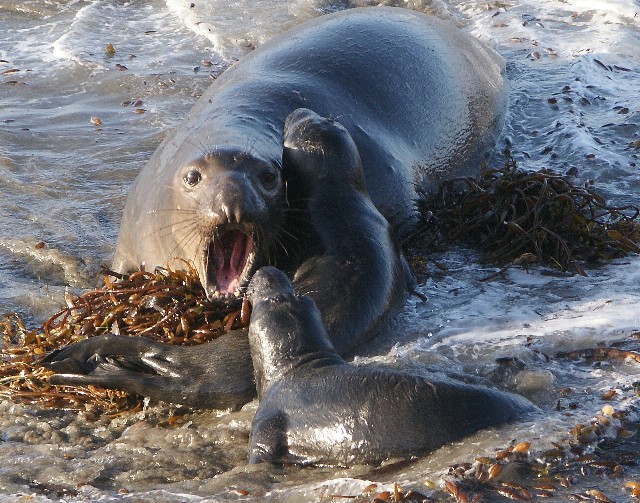
Females Resting Onshore               Males Challenging in a Bay 
At this time of year, when both the females and males of all ages excluding the adult males come ashore to experience their catastrophic molt, they often choose separate pocket beaches. Maybe they do so because the females don't want to be mounted all the time by young males....and maybe because the males are more intent on asserting their strength, both mental and physical, over each other.

Click here to see photos of both groups.

Although both sexes tend to sleep quite a bit, therein ends the likeness. The once-again pregnant females crowd onto the small beaches and spend much of their time squabbling about one thing or another as they wait not so patiently for the time when they'll leave the central California shores to feed themselves and their growing fetus. How they decide when to leave again is not known. Maybe their hunger pangs get too strong, or maybe they somehow know that their favorite meals are out and about. One thing that is obvious, is that the females seem to prefer spending their time ashore, often on beds of cooling kelp rather than in the chilly Pacific Ocean.

Click here to see video of some of the females.

The males, on the other hand, tend to occupy their coastal-time by constantly challenging other males. These challenges take place both in the shallows as well as on land. From the day they're born, male elephant seals almost constantly challenge one another...presumably for supremacy.

Click here to see video of some males relaxing in a bay.

These groups will soon be on their way in search of food, and won't return to these shores until early fall. The next group to come ashore starting in late June will be the adult males.

Saturday, April 27, 2013

Female Catastrophic Molting Time


Many of the females of all ages are now lounging around our beaches as their old fur along with its skin peels off to reveal their nice new silver gray fur ready for use.

This is probably the only time of year that the females actually club together without too much bickering. For some reason, these newly impregnated females nearly always seem at odds with elephant seals of all ages and of both sexes. Maybe it has something to do with that they're either being mounted and/or pregnant for most of their adult lives !?

Click here to see video of some of our current female visitors.

Along with the females, you can see youngsters born a couple or three years ago as well as few weaners from this recent birthing season.


As we head into May, more of the young males will be showing up to take their turn at the catastrophic molt. These are the fun ones to watch as they're almost constantly on the move and participating in numerous hierarchical physical bouts.

Click here for more photos of the current visitors.

Tuesday, January 17, 2012

Protecting Pups from High Tides


With the birthing season in full swing, I thought I should cover some of the ways the elephant seals try to protect their pups when huge ocean swells combined with high tides temporarily take over the beaches.

Some females often place themselves between their pup/s and the sea. Some try to find a high spot like a good bed of kelp. Some try to move up creek beds or low-lying bluffs. Some just keep moving around.

If a pup does get taken out by a surge, however, the next wave will usually bring it right back in. When a pup gets swept out, its frantic mom will usually dash off into the surf in search of her offspring to guide it back to shore. Not only do the moms take action but even the males can oftentimes be seen getting into the act of helping out by guiding the pups back towards shore.

Click here to see video from a recent high surge event.

Since I've been researching the elephant seals, I often hear misleading statements about various aspects of their behavior. Because of these many misconceptions, I've decided to voice my thoughts on some of these based on my observations.

Below are some of the beliefs that I believe should be addressed.

Belief #1: Pups can't swim
False: Pups can swim...after all they are marine mammals born with the innate ability to swim. However, they don't have the necessary blubber to keep them warm. So if they get taken out in the tidal surges too often during their first couple of weeks of life, the very chilly waters of the Pacific Ocean along the central coast of California can cause them to suffer from hypothermia. This, of course, causes an inability to move resulting in their drowning.

Belief #2: Males kill pups
False: The males I've observed over the past several years tend to show a lot of tenderness towards the pups and try to avoid running over them when they're moving at full charge. ( The few times I've seen a pup getting run over by a massive bull, the youngster has bounced right back up protesting loudly ! )

Belief #3: Females are highly protective of their pups
True: Most females go to great lengths to protect their pups from any perceived threat, such as anything/anyone encroaching within a few feet of them. This aggressively protective behavior can include going after pups separated from their moms and the milk supply. Some females will even go so far as to bite and/or remove other pups from their vicinity by tossing them into the air. On the other hand, some females will take on pups that they didn't give birth to and nurse and protect them.

Belief #4: Males will mount anything
True: All males except the most senior ones always seem to be ready to mount any size, any age, any sex elephant seal at any given time. Not that they ever get anywhere in these desires...it just seems to be a part of their nature.

Belief #5: Adult Male Elephant Seals are always extremely aggressive
False: Adult males are generally not aggressive. For the most part, they tend to be rather mellow. There are times, though, when the mood strikes, that they will charge and attack other males after a series of ritualistic aggressive moves. Even on land, they can move extremely fast and cover several hundred yards at a good clip. Although hard blows can be exchanged and blood drawn by bites from their long canine teeth, truly serious injury or death are not par for the course.

Belief #6: They throw sand on themselves to stay cool
False: The reasons elephant seals throw sand on themselves is no doubt multifold. However, the belief that it helps them stay cool doesn't seem all that logical. ( If they're really hot, there's plenty of cool water in the Pacific. ) From my observations, one of the primary purposes of covering themselves partially with sand is a signal to others to leave them alone. ( They may even believe that the sand makes them invisible much as the ostrich seems to feel when it buries its head in the sand. ) Females also throw sand in the face of an amorous male as a deterrent to keep him and his unwanted advances at bay. Thirdly, females often bury the afterbirth by tossing sand on it to hide from the raucous ever-hungry gulls.


Returning to this birthing season's happenings...more adult males have come in. Yet, for the most part, they're still in a very mellow mood this time around with major bouts of fighting not taking place, and many females have still to give birth.

Click here to see recent photos.

Friday, June 24, 2011

Now for the Bigger Males


With the pregnant adult females apparently loathe to depart on their BIG summer foraging trip, many of the sub-adult male elephant seals have been reluctant to come ashore and get picked upon by these queens of the marine mammals. Instead, they have mainly chosen to stay just off-shore bottling and lazily swimming around in the shallow bays. The few males that did venture ashore tried to hide quietly amongst the restlessly quarreling moms without getting booted off again. ( Adult female elephant seals are infamous for picking on each other and keeping unwanted suitors/intruders from getting too chummy.)

Click here for photos of females.

However, as June draws to close for this year, and with these ruling females gone, the favoritized beaches are beginning to fill up with bigger males.

Click here for photos of sub-adult males and juveniles.

As we move through the summer months of July and August, we should see quite a few of the large male elephant seals taking up month-long residencies on the beaches of the central coast of California so they can go through their catastrophic molt and get some shore rest.

Click here to see video of adolescent males ganging up on an intruding male.

Currently, dominancy fighting is not at a premium as the newly arrived males are getting some R&R after their first long feeding trip of the year. But, as they recoup, no doubt their usual squabbling and hierarchal clashes will commence once again.

Click here for photos of bigger males.

Friday, May 13, 2011

Mostly Adult Females


Almost all of the favored elephant seal beaches are so packed with the big adult female elephant seals that it's hard to spot any sand. Most of these pregnant female seals have finished molting for this season but are still resting up on the beaches before heading back out to sea to feed.

There are still a few juveniles also hanging around, but all this year's weaners have finally left on their first BIG foraging voyage.

The next group to come in mass to molt will be the sub-adult males. With so many adult females still enjoying our coast, beach space will be at a premium as the guys start to come ashore in larger numbers. In fact, one can already see and hear a few of these young males both in the water and on land.

Click here for more photos. ( Because we've had so many unusually calm days, many of the photos show the elephant seals doing their thing under water for a change. )

Click here for video of females relaxing in the tidal surges.

Click here for video of young male having a relaxing time in a bay.

Click here to see video of young males trying to make decisions.

Friday, April 15, 2011

Molting Time for Females and Juveniles


The first group of elephant seals to return to the beaches on the central coast of California to start their molt are the adult females. Pregnant once more, and having regained their lost weight during the recent birthing/mating season, they have once again taken over their favorite beaches in order to rest and shed their old fur, which has become tan-colored over time. Some of these adult females are really huge...close to 10 feet in length and looking rotundly healthy after only having been absent for a month. It's hard to believe that they left about a month ago looking thin and worn out.

The catastrophic molt, as it's called, takes close to one month to complete. During this time the 'old' fur and attached skin comes off in large pieces so that the new sleek gray fur can be exposed and readied for 'duty'. During this changeover, the elephant seals seem more sensitive to heat than otherwise and can be seen lying either at the water's edge or swimming in the cool Pacific waters if the mercury starts to rise.

At this time, since there are no large males around, the adult females are the dominant ones on the beaches. Amongst these constantly bickering females, one can also see molting juveniles of both sexes and quite a few newly-arrived weaners that are beach-hopping their way to the hunting grounds.

One- and two-year-old elephant seals sometimes suffer from scabby molt, believed to be a skin disease rather than a true molt. ( Click here to read more. )

As April proceeds, sub-adult males will start to come ashore to start the molting period.

Click here for current photos.

Thursday, March 17, 2011

Weaners Galore


Since the threat of a far-reaching tsunami caused by the devastating 9.0 earthquake in Japan has finally dissipated, one would think that the elephant seals camped out on the shores of the central coast would continue their regular business.

Most of the current elephant seal population is composed of this year's pups, who recently matured into weaners. The majority of these have gathered together in oversized weaner pods on just a couple of the local beaches in the Piedras Blancas area instead of being dottted along the coast as in previous years.

An observer might be amazed as the members of the weaner pod at the north end of the Piedras Blancas viewing center seem to be unusually active, feisty and agitated - biting and snapping at anything and everything that's in their vicinity rather than mainly sleeping away their days, conserving energy. Extreme backbends also seem to be the order of the day as many of these maybe not-so-small twirling dervishes are making the most of a pool formed through a combination of high tides and water deposited from a large agricultural drainage pipe.

Click here to see video of weaners in pool.

Another interesting point is the amount of large adult male elephant seals that are still present. One could say that they're there to protect the weaners. But are they ? Scientists believe that the adult males are only interested in mature females. However, my observations of the adult males would seem to point to their protective nature not only towards females but also towards the pups and/or the weaners.

So far, only a handful of the females have returned to the beaches to rest and start their catastrophic molt. Additionally, on some of the small pocket beaches, a few well-fed young males have already hauled out to begin their molting period.

Click here to see more photos.

Friday, February 25, 2011

Pups Becoming Weaners


All but the last few exhausted mommy elephant seals have left to replenish their rapid weight loss which took place during their month-long shore sojurn. Giving birth and suckling their pups without possibility of leaving land for about 28 days to get some sustenance caused them to lose about 1/3 of the body weight they had when they first came ashore this winter.

The pups, most of whom are more than chubby this year, have been renamed weaners, weaned from suckling, and their only adult protection now is from some of the remaining large males.

Many of these weaners hang out in varying-sized groups known as weaner-pods. Whether they do so for safety in numbers, for comfort from physical closeness to others, for warmth, for the social aspect or what, the scientists are not sure. One thing is sure, though, their interactions with one another are often hilarious to watch.

Over the next month or so, the black/brown pup fur will be exchanged for the eye-catching silver gray fur that's specific for the weaners during their first year. Like all sea-going creatures, their new backside fur is darker than their belly fur, making them less visible to their predators in the ocean.

During their first month as weaners, they will start exploring the shallow tide-pools and/or creeks honing their vital foraging, swimming and diving skills. In so doing, they often get caught up in the ocean currents and land up, intentionally or otherwise, at a different beach, which I call this beach-hopping.

My next posting will deal with the adventures of maturing weaner.

Click here for more photos.

Monday, February 14, 2011

Mating Season


Even though there are still quite a few young pups sticking close to their protective moms, more and more females are coming into heat as their pups pass the three-week-old mark.

Many of these females are still displaying feisty behavior struggling to free themselves from ardent males by twisting and turning and even placing some good nips on the male's sensitive trunks or ripping at the cornified chest shields. ( The females seem to rule the roost ! )

Click here to see video of mating.

As this year's suckling phase nears its end, thinner than usual females seem impatient to quickly leave their fast maturing pups and head back out to sea to find some much needed nourishment to replenish their weight loss.

However, the male elephant seals, and there are an unsual amount of them this year, are insisting on trying to mate with as many of these obviously exhausted females before the 'gals' leave on their much-needed rejuvenation trip.

( Maybe because the weather has been unusally sunny and warm and the traditional foggy mornings and evenings absent, many of the elephant seals seem more drained than in other years.)

The BIG alpha males, the ones that won the hotly-contested territorial fights, are still jealously guarding their harems of females that are still ashore. Many of these large beachmaster males have intensified their determined dashing up and down the beaches over the past couple of weeks, as more and more uninvited amorous suitors keep trying to sneak ashore after playing the patient alligator in the shallow coastal water. Interestingly, the smarter alphas on the smaller beaches, can be seen exchanging the exhausting land patrol for the much easier and more efficient swim patrol in the shallow waters when the tidal water is high enough. Rocks that protrude above the surface of the shallow water are used to hide behind both by the protector and the intruders.

An amorous intruder might try to sneak quietly undetected by the alpha male up to a group of females, making himself as flat and unobstrusive as possible. To no avail. The females will soon make loud deep barking sounds to alert their protector, the big alpha male. This heavy-weight of all heavy-weights will then come rushing over to convince the uninvited suitor to remove himself. Sometimes, the suitor dashes off to another beach via the sea, or he'll just move off a little ways and wait for the opportunity to try again.

Some would-be suitors are not so subtle and attempt to physically challenge the resident head-honchos. This challenge usually ends very quickly with the wishful mater-to-be being chased off the beach with little or no physical contact.

Click here to see more photos.

Thursday, January 27, 2011

The Elephant Seal Mom


As soon as the pup is born, bonding takes place between mom and pup by each smelling the other, and in so doing, imprinting each other’s scent, the only sure way to ID one another in the melee of the elephant seal colony. ( The rather helpless newborn is completely dependent on its mom for survival.)

The immediate main mission of the mom for the following 28 days is to PROTECT her pup at all costs. To this end, she likes to keep a clear space around her and her not-too-swiftly moving pup to help in the defense against aggressive seals of either sex. ( To the eager onlooker, it appears as though the moms are continually bitching and then quickly turning to reassure themselves that their pup is OK.)

Click here to see video of bickering females.

If a prospective male suitor comes over to mate with an unready and unwilling mom, she tries to lure this ardent guy away from the vicinity of her pup by wiggling her tail-end and acting as though she wants to mate. Once lured over to her, the would-be-mate finds his advances are not welcome as the come-hither wiggling stops, sand is flung in his face, and he will probably also get some sharp nips from the protective mom before she hurries back to her pup.

Another problem the mom has to guard against is her dependent pup being run over by large males charging frantically across the beach trying to escape being attacked by other large males.

Click here to see video of male charging across crowded beach.

The icy tidal Pacific Ocean water is yet another danger to the newborn as too much cold water will chill the pup to the bone and can even lead to death.

Intruders on the birthing beach that the moms try to keep at bay, include raucous and bold gulls as well as the occasional coyote looking for a quick meal of tasty pup.

The other important side to being an elephant seal mom is to get the pup to suckle. If the hungry pup has problem locating the milk supply on the huge body of the female, the mom will use a fore-flipper to keep the pup from heading up towards her head instead of going down towards her tail end where her teats are.

Sound-wise moms and pups communicate almost constantly, but if a mom wants the pup to be quiet, she will even cover the pup’s head with her mouth.

The female emits distinctly different sounds for different situations. For example: the deep bark is a warning sound whereas a series of high-pitched almost staccato sounds indicate anxiety.

Click here to listen to an anxious female.

Click here to listen to female's warning bark.

For more photos, click here.

Monday, December 13, 2010

The Giants Are Starting to Go into Action


The famed giants of the elphant seal world are starting to sleep less and become more active on shore as fight time draws near. In fact, even a few threat-claps can be heard at dusk as these huge males prepare themselves for the inevitable battles over territory.

In the meantime, sub-adult males continue their often quite ferocious dominance battles in the bays of the pocket beaches as well as on land. In fact, gangs of six to eight sub-adult males can often be seen working together to antagonize smaller elephant seals.

The pregnant females do their best to stay well away from the warring factions trying to get plenty of rest in anticipation of their fast approaching birthing and suckling season.

Surprisingly enough, there are still quite a few weaners and other youngsters still hanging around the beaches resplendent in their golden-colored fur.

For more photos, click here.

Wednesday, December 1, 2010

BIG Adult Male Elephant Seals Starting to Show Up

l

Taking a well-deserved nap


As the Fall Haul-Out heads to its close for this year, a smattering of the large adult male elephants seals can already be seen sleeping and snoring on several of the beaches along the central California coast.

So far, the bloody and sometimes protracted fights for territory have not yet begun. This may in part be due to the fact that these huge males are quite exhausted from their almost continual search for food while at sea and need to sleep so they can recoup their massive strength. Another contributory fact might be that there are so few adult males here this early that territory is not yet an issue.

Quite a few pregnant females can also be observed resting on the beaches along with the remaining sparring sub-adult males as well as more than a few left-over weaners and two- and three-year-old youngsters.

The fur of these youngsters, which has changed to a beautiful golden or pale tan color, will be shed during next year's molting season.

Most of the elephant seals look well-fed this year, and their fur lacks the blemishes of last year. Also, the amount of cookie-cutter shark bites seems less than in time gone by.

As the days in December roll by, more and more adult males will be coming ashore and the showdowns for territory will take place more and more frequently until the pregnant females arrive and start to give birth, with the first births coming maybe as early as the middle of December.

To see more photos, click here.

Thursday, October 21, 2010

Fall Haul-Out Continues


As the Fall Haul-Out for 2010 continues, different elephant seals keep coming ashore for some R&R while those that have already spent close to a month on land leave in search of food.

After the young male elephant seals have recovered from their trip to the central coast beaches of California, they start their fights for dominance.

However, the female elephant seals of all ages that come ashore at this time of year do so to get some rest trying to keep their distance from the young and actively aggressive young males.

Expectant onlookers can almost always be assured of being witness to the varying shows of aggression provided by the young male elephant seals in their almost continual fights for dominance both on land and in the water.

All too soon, however, these younger elephant seals will be off to sea again looking for more food. Then, in about six weeks, the big male elephant seals will start to come ashore and the battles for temporary territory will begin.

For more photos, click here.

Tuesday, May 11, 2010

Unusual Amount of Adult Female Elephant Seals


Strangely enough, as we near the middle of May, the amount of adult female elephant seals ashore to molt still seems to be increasing.

( Unconfirmed sources claim that there are many more adult females on the beaches at the Piedras Blancas elephant seal colony this year than in previous years.)

Maybe due to the extreme overcrowding on the part of the adult females, the remaining few of this year's weaners can only be observed on the small pocket beaches that the adult females have chosen not to occupy.

Another point of interest is that the vast majority of juvenile elephant seals also appear to be female this year instead of having about a 50-50 mix.

True, a few juvenile males can be seen mock sparring on the beaches and in the shallows. A couple of sub-adult males can also be found roaring on the beach or in the shallows.

If I were a scientist, I would be wondering why there not only seems to be far fewer juvenile male elephant seals to date this spring, but why the usual male competetiveness also seems to be absent.

Click here to see more photos.

Click here to visit my elephant seal website.

Wednesday, April 7, 2010

Catastrophic Molt


Prime beach space is beginning to be hard to find as more and more large elephant seals work their way up onto the beaches to join the already present weaners. These weaners, who are further honing their swimming, diving, and foraging skills now have to try to stay out of the way of the older elephant seals as hierarchy rules.

Over the last couple of weeks both adult female elephant seals as well as juvenile males ( juvenile male = 1-4 years old ) and juvenile females ( juvenile female = 1-2 years old ) have been crowding onto the beaches of central California to begin their annual catastrophic molt. ( The sub-adult males and adult males will come a little later on for their turn.)

What is a catastrophic molt ? Over a period of many months, elephant seal fur changes color from a gray to dark brown to a lighter brownish hue or even a pale tan.

Maybe this change in fur pigment indicates that the fur becomes less oily over time causing the elephant seal to shed its fur and attached skin about once a year. Also, maybe because the elephant seal spends so much of its life in the salty ocean water, its fur simply has to be replenished as the salts dry it out. Another factor might be that as the elephant seal expands both in length and in girth, it needs to shed its outer layer much like a snake does.

The fur and skin peel off in both larger and smaller pieces revealing the fresh new layer of gray fur below. ( See extra photos.)

During the month this molt takes to complete, scientists believe the molting elephant seals eat nothing even though they often enter the ocean during this period.

Click here to see more photos.

Click here to visit my elephant seal website.

Click here to send a free elephant seal e-card.

Saturday, February 20, 2010

Over-Sized Elephant Seal Weaners


Despite quite a few pups starving to death ( see blog post 2-6-10 ), there also seems to be an inordinate amount of extra large weaners occupying a certain beach on the central coast of California.

The average weaned pup AKA weaner is between 4 and 5 feet long and weighs anywhere from 150lbs to just over 300lbs. ( Bear in mind that when one of these weaners was born a little over a month ago it was 3-4 feet long and weighed 60-80lbs.)

At this one beach, I have been astonished to observe that about 50% of the weaners are extremely huge. Their lengths are 5-6 feet, and they must weigh in at around 500+ lbs.

( Remember, a full-grown adult female is on average 8-9 feet long and weighs anywhere from 800lbs to 1,500lbs....and this is after several years. )

Why have so many weaners grown to this gargantuan size ?

Maybe this phenomenon came about because the moms and their pups became isolated up in the dunes and had plenty of undisturbed nursing time !? Due to the constant high waves and high tides during the merciless winter storms, sheer sand bluff walls were formed keeping the large male elephant seals at bay for several weeks down on the flats of the beach until they were able to wear down the sand walls and climb up into the lofty nursery.

Click here for more photos.