Thursday, January 24, 2013

Pups Still Suckling as Mating Picks Up Steam

It's a busy time on the beaches now....probably the busiest of the whole year. You have the sub-adult males competing with the adult males and alpha males, females of varying ages feeding their pups and trying to keep amorous males at bay, and then there are the pups themselves, Some of whom, have been around for over a month now and have been renamed weaners as their moms have quickly weaned them and taken off to eat. Also...here and there you can see a few stragglers born two to three years ago that have chosen to remain on the beaches rather than go fishing.

For the most part you don't see pups interacting with one another, but when one female takes care of multiple pups for whatever reason, you get to see sibling rivalry and affection.

Click here to see pictures of current inhabitants.


The big males are starting to get antsy as females that gave birth early on in the birthing season come into heat. The females are hungry and want to eat but the males want to mate and won't let the females leave until this has been accomplished or, at least attempted. Many males seem inclined to mate with the more compliant younger females before tackling the more opinionated, feisty older 'ladies'. Mating takes place on land or the shallows where the males can get a firm grip on the oftentimes reluctant females.
( In water, the females are far more agile and can easily outswim a male.)

Click here to see photos of males attempting to mate.

All females, but especially the older ones, have quite a few weapons in their arsenal when it comes to fending off amorous males. They can wiggle and squirm making it hard for the male to get a good grip. They can throw sand in his eyes and face. They will bark threateningly or protest loudly. They will even bite or try to bite the neck of the much bigger and stronger male. If a female keeps this up long enough, the male will back down and wait for a more opportune moment.

Click here to see video of males trying to get females to mate.

Friday, January 11, 2013

Pups, Pups, and More Pups

As we near the middle of January, more and more black, fuzzy elephant seal pups can be seen as well as heard as they hungrily cry out for still more of that fat-rich milk stored in their moms.

If a pup during its first two weeks of life gets pulled into the ocean too many times, it will probably die from hypothermia as it won't have enough fat to protect it from the chilly waters of the Pacific. As marine mammals, pups can instinctively swim but aren't yet equipped with the necessary body warming fat that they will have after feeding for another week or so.

Click here to see video of shivering pups.

People often ask me how to tell the difference between male and female pups. The easiest way is when you can see the underside, but, of course, the pups don't usually co-operate. So, this means looking at the overall size of the pup, the shape of its head, the shape of its fore-flippers, and its behavior.

Male pups generally tend to be bigger and more rambunctious than their female counterparts. Their heads tend to be broader as do their fore-flippers. Male pups also often tend to boss their moms whereas female pups often look anxious and tend to cry in a more beseeching manner.

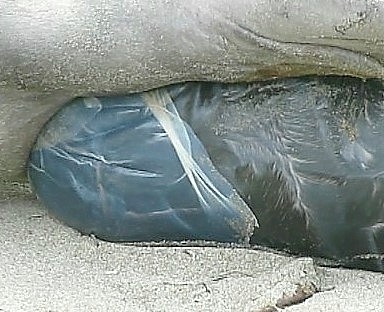
After a pup is born, the mom often tries to hide the bloody afterbirth by covering it up with sand. But, the sharp eyes of the clean-up crews of gulls will soon hone in on this delicacy and down they'll swoop.

When visiting the central coast of California, you will not only be treated to the antics of the elephant seals but might also be privy to a variety of activities performed by some of the other inhabitants of the coastal areas.

There are two kinds of egrets that seem to enjoy the coastal bluffs, the great white egret and the snowy egret. Both of whom like to spend hours fishing.

One of the most noticeable and commonly-seen birds is the large carnivorous California vulture - a nervous bird that feeds on members of the animal kingdom that are very dead and smelly. A few days after the death of a pup, vultures, as well as gulls, can often be seen doing their part in keeping the beaches clean as they meticulously devour each scrap of meat on the bones of a poor youngster.

Cheeky brown ground squirrels are also in abundance, and you might even spot a graceful great blue heron.

Returning to Elephant Seal Land, the birthing season is moving swiftly along with the rapid growth of the pups who will only get this fat-rich milk for 3-4 weeks before mom will dash off to feed herself leaving her pup to fend for itself. During this hectic time, males of many ages and sizes will attempt to mate with any and all females whether they're ready or not. ( I'll take this up in my next posting. )

In the meantime, click here for portraits of some cuddly pups.

Monday, December 24, 2012

Rain, Males and Pups in the News

With much needed rain falling in the area, it does make for a difficult time capturing the latest goings-on ! However, the usual cast of characters are making their appearance...the exciting BIG males, the bursting-to-the-seams pregnant females, left-over busy youngsters, as well as the hungry newborn pups.

Fleeing Confrontation

The first birth of the season, caused much excitement as it took place a little earlier than usual this year, coming before the middle of December !

First Birth

Once again, dragged out and bloody fights between big alpha males have been largely absent. The females, on the other hand, are continuing last year's extremely feisty behavior. Where all this leads to will indeed be interesting !

Squabbling Females

Every once in a while you get an eager-beaver adult male wanting to mate before the female's in heat. When this happens, it's usually with the younger females.

Trying His Luck

Click here for photos of the season.

Click here for video of the Ultimate 5,000lb Male Challenge. Wait till the end as I have to run away from the huge male who wants to challenge ME !


Saturday, December 8, 2012

Mainly Young Males

Even though some of the Fall Haul Out participants are still lounging around, the males of varying ages are the ones attracting the most attention with their almost constant dominance games.

All too soon, though, these younger males will be usurped by the giant adult males and the pregnant females longing to give birth.

Click here to see some of the antics of younger males captured for eternity.

With the weather acting oddly, it's going to be interesting to see if the elephant seal behavior is any different from last year when the females were extremely aggressive from the get-go. They were so aggressive that as far as I could tell, most males were unsuccessful in their mating attempts.

Click here to watch video of virile young males.

Friday, November 16, 2012

Fall Haul Out Almost Over


As the middle of November is now but a memory, so will soon this year's Fall Haul Out be as the shore time for these elephant seals draws to a close.

Despite the fact that the end of November is in sight, quite a few youngsters can still be seen lazing around some of the beaches as well as some young males and a few pregnant females.

Click here for photos of some of the remaining vacationers.

But, as the birthing/mating season approaches once again, the large adult males will start returning to lay claim to a piece of what each one hopes is an ideal spot on the beach for yet another season. Returning too, will the very pregnant females as they beach-hop from one beach to another trying to determine which beach will best meet their needs for birthing and nursing and the inevitable mating.

Click here for video of young males doing their thing.


Saturday, September 15, 2012

Fall Haul-Out Picking up Speed

As we enter the second week of September, more newcomers of varying ages are starting to haul ashore to enjoy their turn on our beaches.

Click here to see more photos of our current visitors.

This fall, a good many of these elephant seals also seem to be unusually generous in 'decorating' our shallows and sandy beaches with their own brand of often brightly-colored fertilizer.

Engaging in struggling with seaweed at this time of year is also a favorite past-time of many young males. Experts have often wondered if elephant seals actually swallow the seaweed/kelp that they toss around. From my observations, it would seem as though they do. The process is often a long and laborious one as the elephant seals have no means to hold the long strands as they strive to break off a bite-size piece. Instead, they have to shake/toss the seaweed till a small piece is broken off. Then the broken off piece has to be carefully maneuvered into just the right position in the mouth so it can slide down the throat without causing the elephant seal to choke on it. To successfully facilitate this rather difficult process, the elephant seal often drinks large amounts of seawater to help in the actual swallowing.

Why elephant seals choose to eat seaweed/kelp is not clear. Maybe they do so for the same reason dogs eat grass...to aid in digestion.


Click here to watch video of young males struggling to swallow some seaweed. ( Some of the video has been slowed down to better show the action. )

As we proceed further into the Fall Haul-Out, more and more elephant seals will come ashore to get some R&R before heading out once again to feed before the birthing/mating season that will start sometime in December.


Thursday, August 30, 2012

Youngsters Starting to Come Ashore

Unlike last year, as August draws to a close, almost all of the big male elephant seals have already set off in search of food.

Click here for photos of some of these big males as they went about their daily business before leaving in search of food.

And click here to see adult male elephant seals in their underwater environment.

So far only a few of the next group of 'vacationers' have ventured ashore. These first early-bird arrivals of the Fall Haul-Out are some of this year's weaners and youngsters, born 2-3 years ago.

Click here to see photos of these early arrivals.

Although some of these young elephants seals of both sexes are relaxing and sleeping, some of the more energetic puppy-like young males are already getting into dominance bouts of playful wrestling.

Click here for video of young males play-wrestling.

A few of the more adventuresome young males, on the other hand, like to test themselves by engaging slightly older male members of the group in challenges. Instead of being really aggressive, these older young males, however, tend to usually act amused and take it easy on these upstart youngsters.

Click here to see video of youngsters challenging slightly older elephant seals in a narrow inlet.

In the coming weeks, as the Fall Haul-Out gets into full swing, more and more youngsters will come ashore to relax and wrestle, and along with them, will also come some pregnant adult females and sub-adult males. ( The Fall Haul-Out usually lasts from September into November. )